Advertisements


Two Charleston interior designers share their advice for selecting, sizing, and displaying artwork that tells a story and makes a home feel personal and complete.
Written by Josh Walker
Staring at a blank wall can be surprisingly intimidating. It just feels like it needs something, but what? Artwork. But how big? What color? What style? Should it complement the room or command it? Should you invest in an original piece or choose something simply because you love it? And how do you know when you’ve found the right piece?
Interior designers Melissa Hay of House of Hay and Kristen Mills of Inch Projects answer those questions by getting to know the people who live with the art.
“I typically will look at the client first and see what they already have in terms of artwork,” Mills said. “It helps me get to know the client and learn their stories.”
“Is it the story of a family? Is it the story of travel?” Hay asks.
Maybe it sounds simple at first, but it’s a powerful idea: All those photographs, postcards from travel, or pieces of art you couldn’t pass up—they could tell the story of a life well lived if only they had the right stage.
You don’t necessarily need to buy anything new, though it’s nothing to fret over if you simply couldn’t walk away from a piece. Do take inventory of what you already own, though. The pieces your rooms need may be waiting to be rediscovered in a shoebox or attic, and there are ways to grant them new life.

Photography by Isabelle Lewis
Start With the Story
Artwork collected while traveling, inherited from family, or purchased during an important chapter of life can give a home something no showroom can replicate: history.
Mills often discovers sentimental pieces clients have held onto for years without knowing what to do with them. In one project, a client had small pieces painted on cloth that she had brought home from her honeymoon nearly 20 years earlier. They had never been properly displayed. Mills had them professionally framed and incorporated them into the home.
Another client had a piece of needlepoint she had made decades earlier. When Mills discovered it among her belongings, the client initially dismissed it.
“She said, ‘Well, I mean, that’s not worth anything,’” Mills recalled. “ I said, ‘But you did this.’” The needlepoint was reframed and now hangs in the kitchen of the client’s new home. “Honoring the honeymoon pieces, the heirloom pieces—I think those pieces are the most special,” she added.

Photography by Bailey Baker
Hay takes a similar approach, considering whether a collection can tell a larger story through different mediums. A gallery wall, for example, might combine a canvas with photography, watercolor, and three-dimensional objects gathered through a homeowner’s travels. The goal isn’t necessarily uniformity.
“Something like that really brings a lot of interest and tells a story,” she said. “One of the things that I love to look for in vintage shopping are frames. I bought a really beautiful piece of tramp art from Paris and brought it home with me. I also had a really beautiful one-of-a-kind butterfly oil by an artist named Shelby Hamilton that I’ve been saving. So, I just put the frame and the Shelby piece together. It’s like a fun balance and mixture of old and new.”

Photography provided by Melissa Hay
Focus on Framing
One piece of advice both designers reiterated freely: don’t underestimate framing. A small piece, for example, isn’t necessarily limited to a supporting role.
Mills cited an example of a postcard collected on a honeymoon. Rather than placing it in a conventional tabletop frame or hanging it as a 5×7, a custom framer could surround it with an expansive mat and substantial frame; give it some texture and presence and transform something physically diminutive, but with huge sentimental value, into artwork capable of commanding a wall and starting a conversation.
“Framing can be art in and of itself,” Mills said. “The piece of art itself doesn’t have to be a major investment from a financial perspective.” If you find yourself digging through long-lost storage containers after reading this, Mills recommends Artizom Framing in Charleston.
“The frame and the matting can become almost as powerful an experience as the art,” Hay agreed. For some failsafe framing magic, she loves Accent Framing and Gallery in Mount Pleasant.

Photography by Kelly Parrish
Hay also scouts vintage finds with an eye for value beyond dollars and cents. A small watercolor, sketch, or oil painting can be floated, over-matted, and given a beautiful frame, allowing the presentation to become part of the artwork itself.
A family heirloom framed decades ago may still be meaningful even if its mat and frame no longer work with a space. Melissa favors preserving the artwork while reconsidering everything around it. “We want to respect the integrity of a family heirloom,” she said, “but let’s bring it back to modern day.” The result can look as though a classic piece has always belonged in a newly designed room.

Photography by Kelly Parrish
Decide Who Gets to Be the Main Character
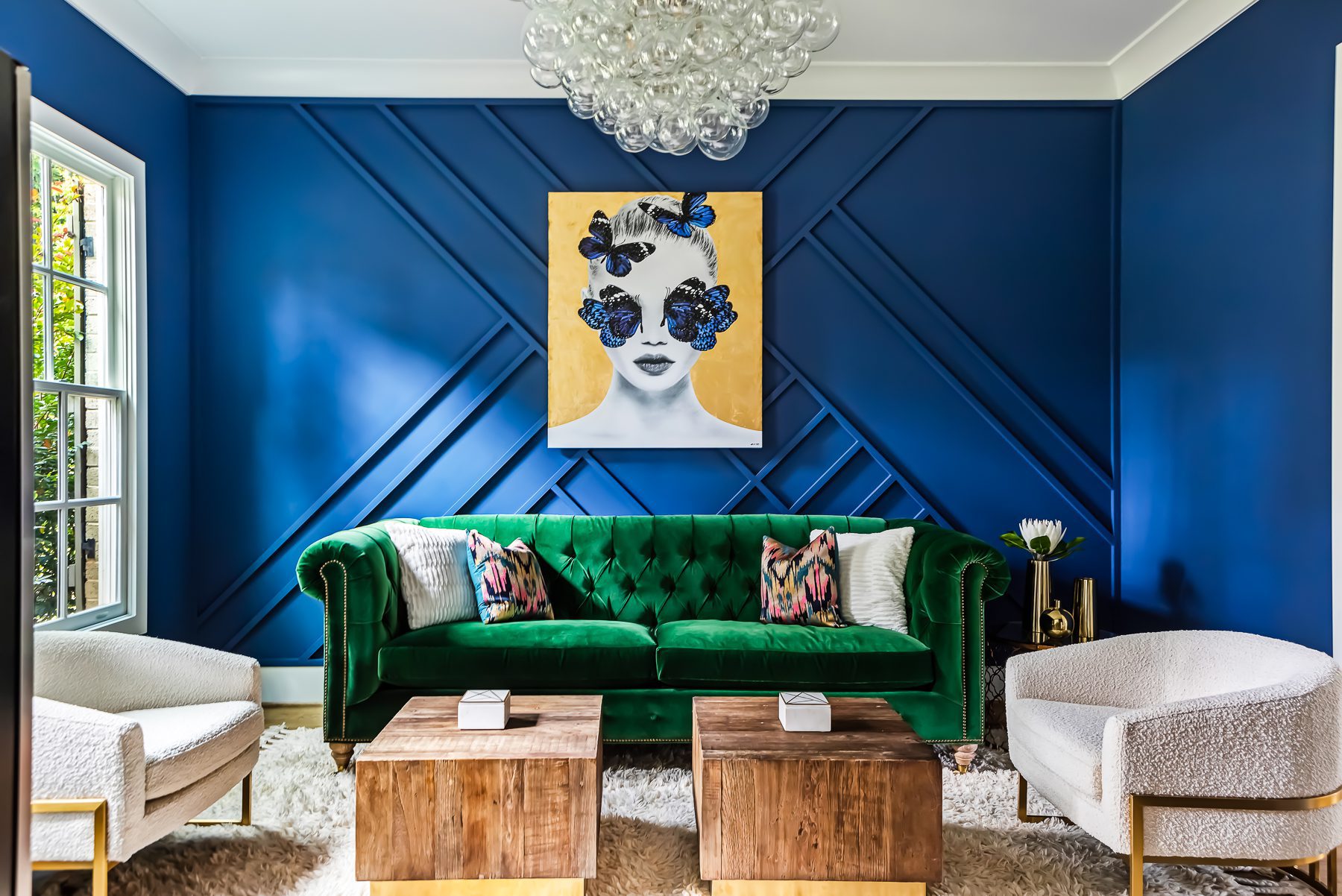
One of Mills’ simplest rules is: decide whether the artwork is the star of the room or part of the supporting cast. “It should never try to be both,” she cautioned.
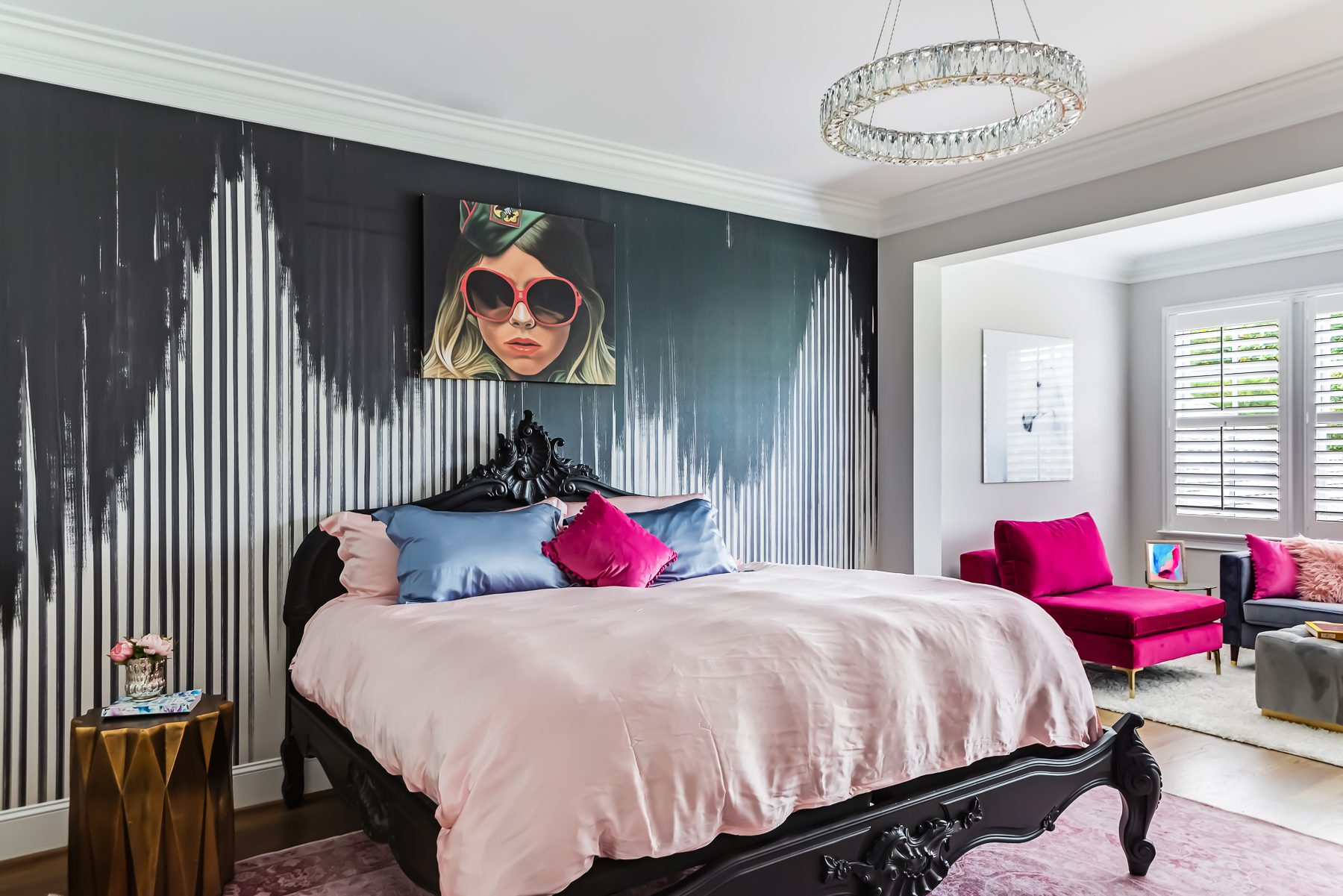
A boldly colored painting or highly graphic work doesn’t necessarily need equally assertive furniture surrounding it. Mills might instead balance it with layers of softer textiles like upholstery, leather, pillows, or wallpaper. That allows the artwork to take the lead. Likewise, when another element of the room carries main character energy, artwork can play a quieter role.

Photography by Kelly Parrish
The difficulty comes when homeowners fall in love with everything. “Sometimes clients get excited because they see all these beautiful things,” Mills said. “They see beautiful wallpaper, beautiful fabric, beautiful art, beautiful tile, and they want all the standouts.”
When that happens, she recommends thinking of the room as a composition: “One main feature and several supporting elements working together,” she clarified.

Photography by Catherine Nguyen
Embrace Contrast
Artwork doesn’t necessarily need to speak in the same voice as the room it’s in. Hay actually prefers when it doesn’t. In a dark, traditional study or piano room, for example, she might introduce a striking contemporary piece rather than artwork that follows the same traditional vocabulary. That juxtaposition keeps the eye moving and creates something unexpected. “Not everything has to fall in line,” she said.
It’s a tale as old as time: Some art dramatically rejects norms. It rejects the sofa, rug, and pillows in a brazen act of rebellion. You can probably see that piece in your mind now. Sure, they still need to coexist with the room, but sometimes the aesthetic tension they bring is what makes them ooze with main character energy and pull you into their orbit.
Mills recalls sourcing large, colorful vintage artwork that ultimately changed the direction of an entire room. “When someone looks at art, there’s a feeling that it evokes that compels you to have it in your space,” she said. “If that kind of spark hits you, then it might be the signal you need to shift gears on design.”

Photography by Ruta Smith
Pay Attention to Scale
For all the freedom involved in selecting artwork, scale is one place where a little guidance goes a long way.
“I would rather see a big piece than a piece that looks too small for a big wall,” Hay said. She likes 60 inches of height from the floor to the center of the artwork as a starting point, which places its center near eye level rather than allowing it to float toward the ceiling. “I have a pet peeve of things that are hung too high,” she added.
While the laws of scale and position are slightly more settled than others, there are still some glimmers of flexibility in this realm for those with enough creative patience. An enormous canvas in one room can be followed by a tiny, beautifully framed piece in a powder room, over a bed, or as a story up a staircase. The contrast itself, then, becomes part of the experience. It paces the story it tells.

Photography by Bailey Baker
“In dining rooms, I like something that is more abstract or is very calming,” Hay said. “You want to provoke more of the conversation. In a family hallway or a study, focus on travel experiences or more personalized pieces.”
Try Before You Buy
Artwork changes throughout the day, seasons, and over the years, especially when it plays with natural light. A painting that feels too yellow or intense under gallery lighting at night may look entirely different in diffused morning light. That’s one reason Hay likes working with galleries that allow designers and clients to take pieces out on approval.
“Just live with it a little bit,” she advised. “You can gain a baseline and see how you would like it in your day-to-day.”
Living with a piece in its proposed habitat offers homeowners a leisurely engagement period rather than immediately tying the knot based on a photograph, showroom visit, or first impression. Like any other rider-or-die relationship, a piece of art’s personality can change over time. Choosing artwork isn’t just about whether something looks good on a particular wall. It’s about whether you want to live with it for better or worse.

Photography by Ebony Ellis
Buy What You Love
Original artwork can require a significant investment, particularly toward the end of a project when a homeowner’s wallet may be feeling a little thin. However, Hay and Mills both caution against treating art as an afterthought.
Mills calls it “the finishing piece.” The right artwork can tie an entire room together, she said, whether it was envisioned at the beginning or discovered at the end of the design process.
Hay also emboldens homeowners to conquer the fear of making the wrong choice. “When you find a piece of art that you really do love, it’s worth the investment,” she reassured, comparing the experience to finding the right mate: “When you know, you know.”
That doesn’t mean every wall requires an expensive original. Prints can make sense in children’s rooms, media rooms, or anywhere a homeowner wants scale and impact while stretching a budget. But when the opportunity arises to purchase an original, particularly from a local artist, Hay sees value beyond the immediate design. “It could be a piece that you’ll hand down to your kids and grandkids someday,” she said.
Ultimately, that’s what separates choosing art from simply filling a blank wall. The best collections are assembled over time from things that evoke a feeling within you. That’s what art does. It reminds you of somewhere you’ve been, connects you to someone you love (or someone you used to be), or simply makes you stop and look twice. Time to give that piece in the attic a second look.




Advertisements


Website Development & Hosting by: Colophon
© Copyright 2026 Charleston Home + Design Magazine. All rights reserved.